The Rise of the Handleless Kitchen: Precision, Elegance and Enduring Appeal
There is a moment, standing in a truly well-designed kitchen, when you realise that nothing is superfluous. No unnecessary detail, no visual interruption — just an unbroken sweep of cabinetry, surface and light that feels simultaneously architectural and deeply inviting. This is the promise of the handleless kitchen, and in 2026, it has never been more compellingly realised.
Once associated purely with the cold minimalism of commercial interiors, the handleless kitchen has undergone a remarkable transformation. Today, it is the preferred choice of architects, interior designers and discerning homeowners who understand that restraint, when executed with precision, is the ultimate expression of luxury. At Dajon Interiors, we have watched this movement mature from a niche preference into the dominant aesthetic across the high-end homes of Gloucestershire — and we have spent years perfecting how to deliver it.
What Exactly Is a Handleless Kitchen?
The term encompasses several distinct design approaches, and understanding the differences is crucial to achieving the result you want. At its simplest, a handleless kitchen removes the traditional bar or cup handle from cabinet doors and drawers. But the sophistication lies in how that opening mechanism is replaced.
J-Pull and Finger-Pull Profiles
The most common approach, and arguably the most elegant, is the integrated J-pull profile — a recessed groove built into the top or underside of each door and drawer front. Running your fingers beneath the door and lifting naturally opens the cabinet, creating a gesture that feels almost choreographed. The profile itself becomes a design detail: a precise shadow line that adds depth and rhythm across the entire run of cabinetry without interrupting its surface continuity.
Variations include the channel pull, where the groove runs along the full width of the door, and the finger-pull, a smaller, more discreet recess suited to lighter doors and minimalist schemes. Each approach creates a subtly different visual cadence along the cabinetry — something our designers at Dajon Interiors take considerable care in selecting for each individual project.
Push-to-Open and Servo-Drive Systems
At the more technologically sophisticated end, push-to-open mechanisms eliminate any visible profile entirely. A gentle press on the door front releases the latch and the door opens smoothly, with no visible mechanism whatsoever. Servo-drive systems take this further still, using motorised hinges that respond to touch — a feature that transforms the daily ritual of cooking into something quietly theatrical.
These systems demand exceptional cabinetry engineering. The tolerances involved are extraordinarily fine: doors must hang with absolute precision, and the internal hardware must perform consistently across years of daily use. It is here that the quality of the manufacturer and the expertise of the installer become inseparable from the beauty of the final result.
Why Handleless Design Suits the Modern Luxury Home
Visual Continuity and Architectural Scale
In open-plan living spaces — the dominant layout in new-build luxury homes and extensively renovated properties across Gloucestershire — the kitchen must hold its own as an architectural element. When a kitchen opens directly onto a dining room or living area, any visual busyness in the cabinetry design becomes disproportionately noticeable. Handleless design resolves this tension elegantly: the kitchen reads as a single cohesive form, as resolved and deliberate as the architecture surrounding it.
Floor-to-ceiling cabinetry in particular benefits enormously from this approach. Tall units without handles become wall panels almost — planes of texture and colour that anchor the room without dominating it.
Material Showcase
Removing handles places the material of the door front centre stage, and this is where handleless kitchens become genuinely exciting. Without the distraction of hardware, the beauty of a deeply grained real wood veneer, the cool perfection of an ultra-matt lacquer, or the subtle movement within a ceramic or sintered stone door is allowed to breathe. Every material speaks more clearly when there is nothing to compete with it.
In 2026, the most sought-after finishes combine tactile warmth with visual restraint. Smoked oak and walnut veneers with a satin sheen sit alongside deeply pigmented matt lacquers in tones such as warm graphite, chalky sage and refined off-whites. The interplay between different materials within a single scheme — perhaps combining a textured wood veneer on the island with a smooth lacquer on the perimeter cabinetry — creates a layered sophistication that feels genuinely bespoke.
Practicality That Matches the Aesthetics
It would be remiss to discuss handleless kitchens without acknowledging a common practical concern: ease of use. The honest answer is that a well-engineered handleless kitchen is not merely as practical as a traditional one — for many people, it is more so. There are no handles to catch clothing, no hardware to harbour grease or require polishing, and the smooth surfaces are considerably easier to keep immaculate. For families with young children, the absence of protruding hardware also removes a persistent source of minor injuries.
The critical caveat is quality. A poorly engineered push-to-open mechanism will frustrate within months. An ill-fitting J-pull profile will look shoddy rather than refined. The investment in properly specified, expertly fitted cabinetry is not merely aesthetic — it is functional.
Colour, Finish and Material Directions for 2026
The handleless kitchen's clean canvas has encouraged an increasingly bold approach to colour and material in 2026. We are seeing a decisive move away from the all-white kitchen that dominated the previous decade, towards more considered, deeply personal colour choices that reflect the homeowner's broader design sensibility.
Warm Neutrals and Earthy Tones
Warm putty, pale terracotta, dusty rose and greige — a grey-beige hybrid — are appearing with increasing frequency in luxury kitchen schemes. These tones feel simultaneously contemporary and timeless, referencing the natural palette of the Cotswolds landscape while meeting the demands of modern living. When applied to a handleless kitchen, they create an atmosphere of enveloping calm that is particularly well suited to the open-plan homes of rural Gloucestershire.
Dark and Dramatic
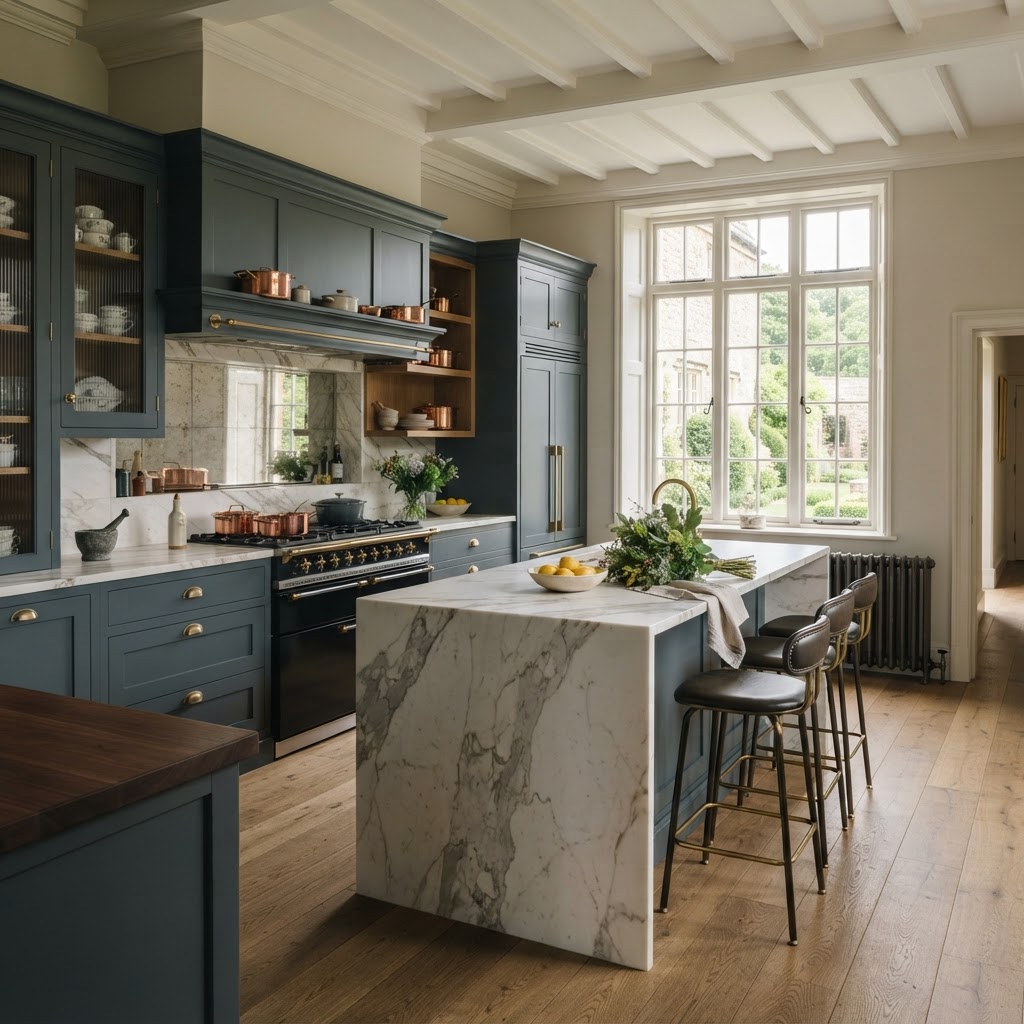
At the opposite end of the spectrum, deeply saturated tones — midnight blue, forest green, near-black charcoal — continue to gain ground in larger kitchen spaces where they can be balanced with natural light and warm material accents. A handleless kitchen in a deep, velvety matt finish, paired with unlacquered brass internal fittings and a honed marble worktop, represents a pinnacle of current luxury kitchen design.
Natural Materials and Textured Surfaces
The integration of natural and semi-natural materials into handleless schemes is one of the most significant directions in 2026. Real wood veneers are more popular than ever, particularly in bookmatched configurations where the grain pattern mirrors across adjacent door fronts. Ceramic and sintered stone door panels bring extraordinary durability alongside remarkable visual impact, replicating the appearance of natural stone with a consistency and practicality that the genuine article cannot always match.
Worktop materials are evolving in parallel. Dekton, porcelain and quartzite are increasingly preferred over engineered quartz for their natural appearance and superior heat resistance — a practical consideration in a kitchen designed for serious cooking.
Designing a Handleless Kitchen: Key Considerations
Lighting
Integrated lighting becomes even more critical in a handleless kitchen, where the shadow lines of the door profiles must be properly revealed rather than lost. Under-cabinet task lighting, interior cabinet lighting and carefully considered ambient lighting work together to ensure the kitchen looks as beautiful at midnight as it does at midday. LED strip lighting concealed within the door profile itself — illuminating the J-pull from within — is a particular refinement worth considering.
Worktop and Splashback Integration
The seamless aesthetic of a handleless kitchen extends naturally to the worktop and splashback. Full-height splashbacks in the same material as the worktop, eliminating the grout line entirely, are the preferred approach in truly high-specification schemes. Mitred worktop edges, where the stone wraps down the front of the island or peninsula, reinforce the architectural language of continuity and precision.
Appliance Integration
Fully integrated appliances — where oven, refrigerator, dishwasher and even coffee machine are concealed behind matching door fronts — are the natural companion to handleless design. The result is a kitchen where the functional elements simply disappear, leaving only the architecture of the space itself.
Handleless Kitchens Across Gloucestershire: A Growing Appetite for Considered Design
Across Gloucestershire, we are witnessing a significant shift in how homeowners approach kitchen design. In the beautifully converted farmhouses and barn conversions of the Cotswolds, handleless kitchens in natural materials and warm tones are providing a contemporary counterpoint to historic architecture — modern precision set against old stone and original timber. In the elegant Regency townhouses of Cheltenham, floor-to-ceiling handleless cabinetry in refined, painterly colours is creating kitchens that feel genuinely architectural, worthy of their magnificent surroundings.
In Stroud, where a creative and design-literate community has long shaped local aesthetic sensibilities, we are seeing some of the most adventurous material and colour combinations — homeowners who have researched deeply and arrive at our showroom with a clear creative vision that we are privileged to help realise.
Throughout the wider Gloucestershire region, the appetite for luxury kitchens that are as well-considered as the rest of the home is stronger than ever. The handleless kitchen — precisely because it demands quality at every level — has become the benchmark against which serious kitchen design is measured. As a kitchen and bathroom showroom in Gloucestershire, Dajon Interiors has seen first-hand how transformative the right kitchen design can be, not merely for the room itself but for the entire home.
You can explore some of our completed projects across the region in our project gallery, which offers a genuine sense of what is achievable when design ambition meets genuine craft.
Why Choose Dajon Interiors for Your Handleless Kitchen?
Designing a handleless kitchen well requires a level of technical precision and aesthetic understanding that not every provider can offer. The engineering tolerances involved, the material knowledge required, the lighting expertise, the appliance integration — each element must be resolved with equal care, or the cumulative effect is diminished.
At Dajon Interiors, our approach to high-end interiors in Gloucestershire begins with listening. We understand that a kitchen this refined is not simply a functional space — it is an expression of how you live, what you value and what you want your home to feel like. Our design process is unhurried, detailed and entirely focused on achieving a result that exceeds your expectations rather than merely meeting a brief.
Our showroom in Gloucester allows you to experience materials, finishes and mechanisms in person — something that no website or brochure can truly replicate. You can open doors, feel finishes, see how light moves across different surfaces at different times of day. For a decision of this significance, that direct sensory experience is invaluable.
We work with clients across Cheltenham, Stroud, the Cotswolds and the wider Gloucestershire region, and our portfolio of completed projects reflects the breadth and depth of what we are able to achieve.
Begin Your Kitchen Journey with Dajon Interiors
If you are considering a new kitchen and the handleless aesthetic resonates with your vision for your home, we would love to hear from you. Whether you are at the very beginning of your thinking or have a fully formed brief ready to share, our design team is here to help.
Visit our showroom in Gloucester to explore handleless kitchen designs, materials and finishes in person, or get in touch to arrange a design consultation at a time that suits you. You can also browse our full range of bespoke kitchen designs, luxury bathrooms and fitted bedrooms to begin building a picture of what Dajon Interiors can offer your home.
In Conclusion: Handleless Design as a Philosophy, Not Simply a Style
The handleless kitchen endures and continues to evolve because it represents something more than a visual preference. It is a philosophy of design — the belief that every detail should be purposeful, that quality of engineering and quality of material are inseparable, and that true luxury lies in the removal of excess rather than the addition of it. For homeowners across Gloucestershire who share that belief, the handleless kitchen is not simply a choice. It is the only logical conclusion.