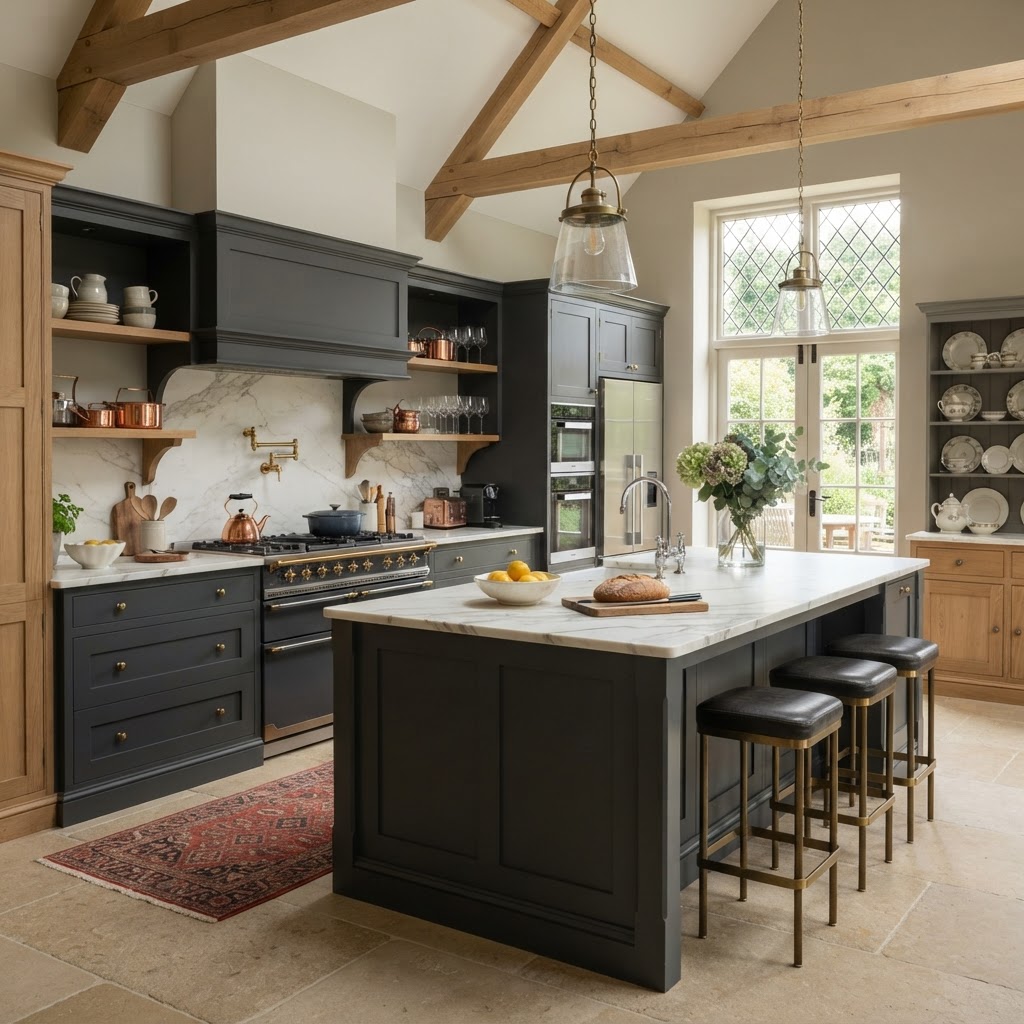
The Cooktop Revolution: Where Precision Engineering Meets Pure Aesthetics
There is a quiet revolution unfolding in the most beautifully designed kitchens across the UK. The overhead extractor hood — once a functional centrepiece above the cooktop — is retreating from view, replaced by something altogether more considered: an induction hob with fully integrated extraction built directly into the cooking surface itself. It is an innovation that feels almost inevitable in retrospect, a seamless marriage of two essential kitchen functions into a single, sculptural object that disappears effortlessly into the worktop.
In 2026, this technology has matured from a novelty into a genuine design philosophy, embraced by architects, interior designers, and discerning homeowners who refuse to compromise between form and function. At Dajon Interiors, Gloucester's leading luxury kitchen and interior design showroom, we have watched this shift transform the conversations we have with clients across Gloucestershire, Cheltenham, Stroud, and the wider Cotswolds. Increasingly, the question is no longer whether to incorporate integrated extraction — it is how to use it to unlock an entirely new vision of the modern kitchen.
Why the Overhead Hood Has Had Its Day
To understand why integrated hob extraction has captured the imagination of luxury kitchen designers, it helps to consider what the traditional overhead extractor actually costs a kitchen — not in pounds, but in spatial and aesthetic terms.
A conventional extractor hood, however beautifully crafted, imposes itself on the kitchen's architecture. It interrupts sightlines, competes with cabinetry, and — in open-plan living spaces that dominate contemporary home design — creates a visual barrier between the cooking zone and the rest of the room. In island kitchens, the challenge is even more pronounced: a ceiling-mounted extractor canopy above a central island can feel oppressive, reducing the sense of openness that makes island cooking so sociable and enjoyable.
Integrated hob extraction eliminates this problem entirely. By drawing cooking vapours, steam, and odours downward through the cooking surface itself, these systems remove the need for any overhead extraction at all. The result is a kitchen ceiling that remains uninterrupted, sightlines that flow freely, and a cooking zone that presents itself as a clean, minimal plane of precision-engineered glass or stainless steel.
The Engineering Behind the Elegance
It would be easy to assume that the appeal of integrated hob extraction is purely cosmetic — a triumph of design over practicality. In fact, the engineering is extraordinarily sophisticated, and in many respects these systems outperform their conventional counterparts.
Proximity Extraction
The fundamental advantage of extracting vapours at the point of origin rather than from a height of 60 to 75 centimetres above the hob is efficiency. Cooking odours and steam are captured immediately, before they have the opportunity to disperse into the wider kitchen environment. This proximity extraction principle means that even at lower fan speeds, integrated systems can manage heavy cooking with remarkable effectiveness — reducing both noise and energy consumption compared with high-powered overhead hoods running at full capacity.
Recirculation and Ducting Options
Modern integrated hob extraction systems offer both recirculation and ducted configurations, making them adaptable to virtually any kitchen layout. Ducted installation — where extracted air is channelled out of the building through concealed pipework — delivers the highest performance and is the preferred choice in most luxury kitchen projects. Recirculation systems, which filter extracted air through activated carbon filters before returning it to the room, offer greater flexibility in situations where external ducting is impractical, such as in listed buildings or apartments, which are particularly common in the historic towns of Cheltenham and Gloucester.
Induction as the Perfect Partner
Integrated extraction pairs most naturally — and most effectively — with induction cooking technology, and this is no coincidence. Induction hobs generate heat directly within the pan rather than at the cooking surface, which means the hob itself remains largely cool to the touch. This characteristic makes the downward extraction of vapours considerably more effective: there is no rising column of superheated air from the cooking surface competing with the extraction airflow. The result is a system that works in harmony with itself, quiet, efficient, and utterly reliable.
Induction technology also aligns perfectly with the values of the contemporary luxury kitchen client. Precision temperature control, rapid response, effortless cleaning, and compatibility with smart home systems — these are qualities that resonate deeply with homeowners investing in a truly exceptional cooking space.
Design Possibilities Unlocked
Perhaps the most exciting aspect of integrated hob extraction, from a purely design perspective, is what it makes possible when the overhead hood is removed from the equation.
The Uninterrupted Island
The kitchen island has become the social and architectural heart of the modern open-plan home. When integrated hob extraction is incorporated into an island worktop, the cooking surface becomes a seamless element within a beautifully considered composition of stone, timber, and cabinetry — with nothing above it but light and space. This is the kitchen as living room, as dining room, as the place where family and friends gather naturally and without barriers.
Dramatic Window Placement
In kitchens where the cooktop sits beneath or adjacent to a window — a layout beloved in Cotswolds farmhouses and period properties across Gloucestershire — the absence of an overhead hood allows glazing to extend fully to the ceiling, flooding the cooking zone with natural light and framing garden views without interruption. It is a detail that transforms the experience of cooking from a domestic chore into something genuinely pleasurable.
Architectural Ceiling Treatments
Vaulted ceilings, exposed beams, dramatic pendant lighting, and bespoke plasterwork are among the defining features of luxury homes across the Cotswolds and Cheltenham. An overhead extractor hood inevitably competes with — or compromises — these architectural moments. With integrated hob extraction, the ceiling is returned to the architect and interior designer as a canvas, free to express whatever character the space demands.
Materials, Finishes, and the Art of the Worktop
When the hob extraction system sits flush within the worktop, the worktop itself becomes a more significant design decision. The cooking surface and the surrounding stone or engineered material must work together as a unified composition.
At Dajon Interiors, our bespoke kitchen clients frequently choose large-format natural stone — Calacatta marble, Pietra grey, honed granite — as the worktop material into which an integrated hob is set. The contrast between the warm, organic veining of natural stone and the precise geometry of a flush induction surface is extraordinarily compelling. Equally popular are ultra-compact engineered surfaces in matt white or charcoal, which give integrated hobs a quality of near-invisibility — the cooking zone becoming simply a zone within the worktop, defined only by the faintest recessed detail at its perimeter.
Serving Gloucestershire's Most Discerning Homeowners
The demand for integrated hob extraction has grown significantly across our region, reflecting both the quality of new-build and renovation projects taking place throughout Gloucestershire and the increasingly sophisticated expectations of homeowners who invest in truly bespoke interiors.
In Cheltenham, where elegant Regency townhouses are being sensitively updated with contemporary kitchens that respect their architectural heritage, integrated extraction offers a way to introduce the very latest cooking technology without introducing visual elements that feel at odds with the period character of the building. In Stroud, where a creative, design-literate community has long championed considered, crafted interiors, the clean geometry of integrated hob extraction aligns naturally with an aesthetic sensibility that values quiet confidence over ostentation. Across the Cotswolds, in farmhouses and barn conversions where vaulted kitchen spaces demand a light touch, the freedom that integrated extraction gives to ceiling design and natural light is genuinely transformative.
As a kitchen, bathroom, and bedroom showroom serving Gloucestershire and the surrounding region, Dajon Interiors works with clients from across this remarkably varied landscape, each with their own vision of what a luxury home means to them. What unites them is a desire for spaces that are genuinely exceptional — not merely expensive, but deeply considered, beautifully crafted, and tailored to the way they actually live. Integrated hob extraction, at its best, embodies exactly that ambition.
You can explore some of the extraordinary kitchens we have created across the region in our project portfolio, where integrated cooking and extraction solutions feature prominently in our most recent work.
Practical Considerations: What to Discuss with Your Designer
If you are considering integrated hob extraction as part of a new kitchen project, there are several practical dimensions worth exploring with your designer before committing to a specification.
Ducting routes require early consideration, particularly in renovation projects where structural elements may constrain where pipework can be concealed. Power requirements for high-performance integrated systems are greater than for standard hobs and should be factored into electrical planning from the outset. Worktop thickness and material compatibility with specific hob models is another detail that benefits from early dialogue between your kitchen designer and your stone or surface supplier. These are not obstacles — they are simply the details that a skilled design team manages as a matter of course. At Dajon Interiors, our design consultants guide clients through every technical consideration, ensuring that the finished kitchen reflects the original vision without compromise.
Visit Dajon Interiors: Experience the Future of the Luxury Kitchen
The finest way to appreciate what integrated hob extraction truly offers — in terms of sound, spatial quality, and aesthetic impact — is to experience it in person. At our showroom in Gloucester, we have curated a collection of fully working kitchen displays that bring together the most exciting innovations in contemporary kitchen design, including integrated induction and extraction solutions that allow you to see, touch, and cook on these remarkable systems for yourself.
Whether you are planning a complete kitchen transformation, updating an existing space, or simply beginning to gather inspiration for a future project, our team of experienced luxury kitchen designers is here to help. We work with clients across Gloucester, Cheltenham, Stroud, the Cotswolds, and throughout Gloucestershire, creating bespoke kitchens, bathrooms, and bedrooms of the very highest standard.
The Kitchen Reimagined
Integrated hob extraction is more than a technological upgrade — it is a statement of intent about the kind of kitchen you want to inhabit. It says that cooking matters enough to deserve the finest tools available, and that the kitchen as a space matters enough to be freed from compromises that were always, at some level, unnecessary. In 2026, the luxury kitchen is defined not by what it contains, but by what it has been liberated from: clutter, obstruction, compromise. The integrated hob is, in this sense, the purest expression of that philosophy — a cooking surface that does everything, and asks nothing of the space around it except to be allowed to breathe.